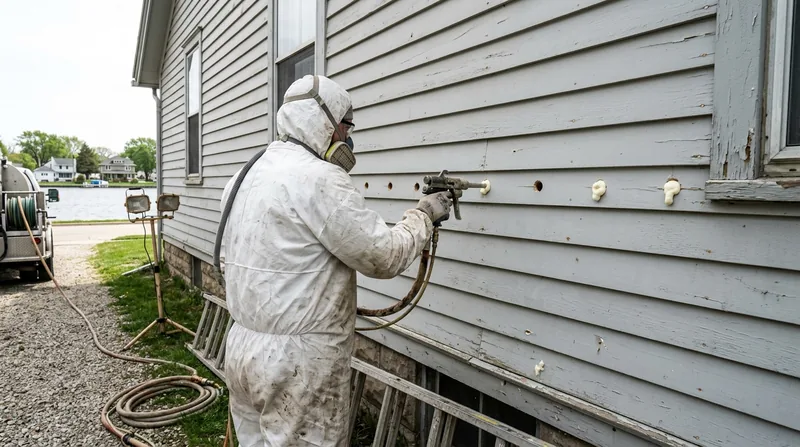




Older Oshkosh homes near downtown and along the Fox River often have wall cavities built without an air barrier, leaving finished walls vulnerable to heat loss and moisture infiltration through gaps around wiring, plumbing, and framing voids. Wall and injection foam insulation fills these cavities through small access holes without opening drywall, sealing the thermal bypasses that cost homeowners real money each winter. Mid-century ranches scattered across Winnebago County frequently show settled insulation or missing batts in critical zones, while newer construction toward Omro and Fox Crossing may have been framed with standard cavity depths that leave cold spots around electrical outlets and pipe penetrations. When winters are long, cold, and windy off Lake Winnebago, every air leak compounds, and the stack effect pulls warm air up through the house and out through the rim joists and attic. Injection foam addresses the walls themselves, sealing voids that fiberglass batts cannot reach and creating a continuous air barrier without demolition. We inject closed cell or open cell foam into finished walls, measuring thickness and density to meet code and deliver real R-value. For a free estimate, call (920) 744-3095 or visit our contact page.
Why Wall and Injection Foam Matters in Oshkosh Homes
Homes built before the 1980s in Oshkosh rarely had a continuous air barrier in the walls. Balloon-framed houses near downtown were constructed with no vapor control, and even homes from the 1960s and 1970s often have insulation that has shifted, compacted, or never filled the entire cavity. The result is cold walls, drafts around outlets and switches, and energy loss that shows up clearly on winter heating bills. Injection foam fills those voids without opening the drywall, sealing the thermal breaks that cost you money every degree the outdoor temperature drops below freezing.
- We drill small access holes into the wall cavity, inject foam to fill voids around wiring and plumbing, and seal the holes when finished.
- Injection foam creates an air barrier inside finished walls, stopping the stack effect that pulls warm air up and out through the attic.
- The process works in living spaces, kitchens, and bedrooms without requiring you to move out or strip drywall.
- Closed cell foam adds structural rigidity and vapor control; open cell foam is lighter and allows drying if moisture enters the cavity.
In Oshkosh, where the heating season is long and Lake Winnebago wind drives cold through uninsulated walls, injection foam is one of the few ways to retrofit finished walls without a full renovation.
Key info: A home in Oshkosh or Neenah with exterior walls that feel cold to the touch in winter, or rooms over unheated spaces like garages, are prime candidates for injection foam. The cost is lower than opening walls, and the air sealing is immediate and permanent once cured.
See our guide to air sealing in Oshkosh for more on how wall insulation connects to the bigger picture of thermal control.
How We Inject Foam Insulation Into Finished Walls in Oshkosh
Injection foam is a straightforward process when done correctly. We locate the wall cavity, drill small holes at strategic points, and inject foam at a controlled rate and thickness so it fills the entire cavity without creating pressure that could bow the drywall or damage the structure. The foam expands slightly, fills voids around wiring and plumbing, and cures to a solid state. We patch the holes with plugs or drywall mud so they vanish into the wall. The entire job happens inside your home, with no exterior disruption and minimal dust.
- We inspect the wall cavity from inside, using thermal imaging or moisture meters to identify cold spots and voids.
- We drill access holes at intervals along the cavity, typically 16 to 24 inches apart depending on stud spacing and cavity depth.
- We inject foam at the correct ratio and temperature, filling the cavity from bottom to top so air escapes and the foam settles evenly.
- We monitor thickness and density with each pass to meet the R-value and code requirements specified in our written estimate.
- We patch access holes and allow the foam to cure fully before you use the room normally, typically 24 to 48 hours.
This method works for exterior walls, walls over garages, and any finished wall where you want to add insulation without tearing out drywall.
Example: A bedroom in a 1960s ranch in Fox Crossing felt cold along the exterior wall even though it had old fiberglass batts. We injected closed cell foam through three access holes, filling the voids that the batts had missed around the electrical outlet and window frame. The wall temperature rose 8 to 10 degrees, and the room was noticeably warmer without extra heating.
If your walls are part of a larger energy retrofit, we can coordinate with attic insulation and rim joist sealing to address all three major thermal leaks in an Oshkosh home.
Injection Foam Methods: Closed Cell vs. Open Cell
| Approach | Description | Best for |
|---|---|---|
| Closed Cell Injection Foam | High-density foam with closed cells that trap air and provide an air barrier and vapor barrier in one layer. R-value typically 6.5 to 7.0 per inch. | Exterior walls in cold climates, walls over unconditioned spaces, and homes where vapor control is critical to prevent moisture damage. |
| Open Cell Injection Foam | Lower-density foam with open cells that allow water vapor to pass through. R-value typically 3.5 to 4.0 per inch. Lighter, less expensive, and easier to remove if needed. | Interior walls, interior wall cavities in homes with good drying potential, and retrofits where cost is a primary concern and the wall has a separate vapor barrier on the interior. |
| Hybrid or Two-Part Injection | Closed cell foam in the outer portion of the cavity for vapor control, open cell in the inner portion to allow drying and reduce cost. | Mixed-climate retrofits and homes where you want vapor control on the exterior side but need flexibility on the interior. |
| Injection Into Existing Fiberglass | Foam injected around or over existing batts to fill voids and improve the overall R-value without removing the old insulation. | Homes where the existing insulation is in place but has settled, shifted, or was never installed fully, and removal cost is not justified. |
The choice between closed cell and open cell depends on the wall assembly, the climate, and your moisture risk. In Oshkosh, where winter vapor drive is the dominant pressure, closed cell is often the safer choice for exterior walls. Open cell can work in interior walls or where you have a clear interior vapor barrier. We specify the right foam type in our written estimate based on your wall assembly and local code.
Wall and Injection Foam Insulation Cost in Oshkosh: What to Expect
Injection foam insulation in Oshkosh typically starts at $2 per square foot of wall cavity filled, though the final cost depends on several concrete factors. The depth of the cavity (whether it is a standard 3.5-inch stud bay or a 2x6 cavity at 5.5 inches), the foam type (closed cell costs more than open cell), the length of the wall, and the number of access holes required all affect the per-square-foot rate. A single bedroom wall might cost $500 to $1,200 depending on its size and complexity, while a full exterior wall retrofit on a larger home could run $2,500 to $5,000 or more. Labor, materials, and overhead are built into that range, and we provide a written estimate with R-value and thickness specifications before any work begins.
Factors that move the price up include walls with complex layouts (many outlets, switches, or pipe penetrations that require more access holes), cavity depths that exceed standard framing, and homes in Appleton or Menasha where travel time is longer. Walls with existing moisture damage or contamination require investigation and may need remediation before we inject foam. We never spray over a wet substrate, and if we find evidence of prior water intrusion, we stop and recommend fixing the moisture source first.
The best way to understand your cost is to request a free estimate. We measure the wall cavity on site, assess access and complexity, and provide a firm price with no surprises. For detailed pricing across different project sizes and foam types, see our full pricing guide.
What to Look for When Hiring a Wall and Injection Foam Contractor Near Oshkosh
Injection foam is a technical job, and the difference between a careful installer and a careless one shows up immediately in comfort, energy bills, and the durability of the foam itself. When you are evaluating a spray foam contractor near Oshkosh, focus on behavior and process, not just price. A reputable contractor will provide a written estimate with R-value and thickness specifications, explain whether the foam is closed cell or open cell and why, and describe the access and curing process before starting work. They will have fully insured coverage and be reachable if questions arise after the job.
Red flags include an estimate with no R-value or thickness listed, a price far below market with no inspection, pressure to book immediately, and promises of immediate re-entry (foam needs 24 to 48 hours to cure fully). Verify any contractor's insurance and ask for references from recent jobs in Oshkosh or Neenah. If you are in an HOA community or a historic district, check whether architectural approval is required for wall work; most HOAs do not govern interior insulation, but it is worth confirming. Wisconsin law does not require a separate license for spray foam insulation contractors, but the local building department in Oshkosh, Appleton, or Fond du Lac may have registration or permitting requirements for interior work, so confirm what applies at your address before signing a contract.
Contact us at (920) 744-3095 or visit our contact page for a free, no-obligation estimate. We will walk you through the process, answer your questions, and provide a clear, written price before we drill the first hole.
Wall & Injection Foam Insulation in Oshkosh: Pricing Guide
| Service | Price | Details |
|---|---|---|
| Single wall cavity (e.g., one bedroom exterior wall) | Starting at $500 | Typical wall 12 feet long, 8 feet high, standard 3.5-inch stud bay, closed or open cell foam as specified |
| Full exterior wall retrofit (larger home) | Starting at $2,500 | Multiple walls, complex layout with outlets and penetrations, includes access holes, patching, and written R-value specification |
| Wall over garage or unheated space | Starting at $1,200 | Closed cell foam recommended for vapor control, walls above garages in Oshkosh and Neenah require extra care for thermal bridging |
| Moisture investigation or remediation required | On estimate | If prior water damage is found, we assess the source and may recommend fixes before foam injection proceeds |
| Travel and estimate | Included in quote | No separate mileage or call-out fee for Oshkosh and surrounding service areas; free estimate response within 24 hours |
Indicative pricing, the exact cost depends on square footage, finish, and site access. Free personalized estimate within 24h at (920) 744-3095.


