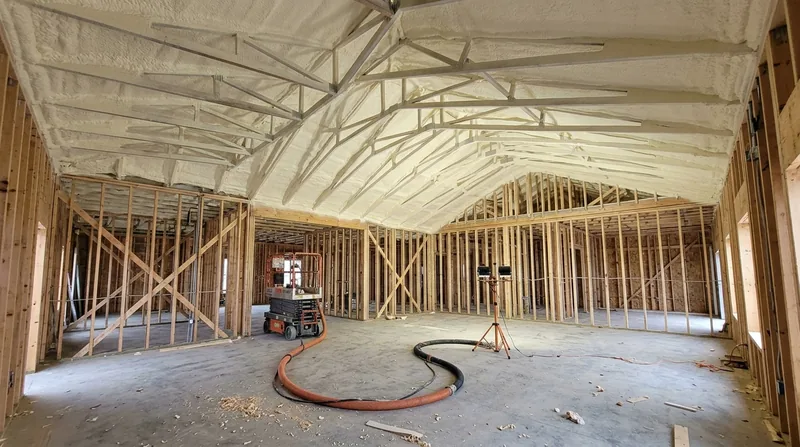




Commercial & New Construction Spray Foam in Oshkosh is built into the building envelope before drywall, roofing, and finishes go in. New construction and commercial shells across the Fox Valley require an air barrier from the first phase, and spray foam delivers that continuity across walls, roof decks, and slab edges in a single application. Oshkosh's building boom pushes outward toward Omro and into Winnebago County, with contractors framing homes and commercial spaces on tight schedules. Getting the thermal and air barrier right during construction costs less and performs better than retrofitting it later. We spray foam new construction and commercial buildings to the energy code that applies at your address, sized and documented before finishes cover the work.
Why Commercial & New Construction Spray Foam Matters in Oshkosh and the Fox Valley
New buildings going up in Oshkosh, Appleton, Neenah, and across Winnebago County are built to code, but code is a minimum. Spray foam applied during framing creates a continuous air barrier that vented fiberglass or blown-in cellulose cannot match. That barrier stops cold air infiltration before winter wind off Lake Winnebago hits the building, and it eliminates the thermal bridging that turns wood framing into a heat-loss highway. Commercial projects especially benefit because energy modeling and operating costs are part of the bid, and an air-sealed building runs lower utility bills for decades.
- We spray foam exterior walls before sheathing or interior finishes, capturing all penetrations and rim details in one pass.
- Roof decks and cathedral ceilings get sprayed from the inside, creating a sealed attic that eliminates venting and ice dam risk.
- Slab edges and band joists are foamed before concrete pours and backfill, sealing the building from the foundation up.
- The installation is documented with R-value and thickness specifications, creating a record for the builder, the inspector, and the owner.
Builders and property managers who specify spray foam during construction avoid the cost and disruption of retrofitting insulation later, and they meet energy codes with a margin built in.
Key info: Wisconsin's energy code requires a continuous air barrier in new construction and substantial renovation. Spray foam applied during framing creates that barrier in one phase, eliminating callbacks and punch-list items later. Verify current code requirements with your local building department before design and bid.
For details on Wisconsin's building code and energy requirements, see your Wisconsin Department of Safety and Professional Services for the current adoption and any local amendments in effect at your address.
How We Work with New Construction and Commercial Builders in Oshkosh
Our process starts with the building plans and energy code in effect at your job site. We coordinate with the general contractor and the framing schedule, arriving when walls are up and roof decks are in place but before sheathing or interior finishes. We spray foam walls, roof decks, and slab edges to the thickness and R-value required by code or specified in the energy model, then provide a signed report with board-foot quantities and installed R-value for the inspector and the builder's records.
- Schedule a site visit during framing phase to review plans and confirm access and spray sequence.
- Provide a written estimate with R-value, thickness, board-foot quantity, and cost broken down by area.
- Coordinate with the general contractor on spray date and any prep work needed (temporary power, ventilation setup, protection of windows and openings).
- Spray foam walls, roof decks, slab edges, and rim details to specification, maintaining proper drum temperature and ratio.
- Document the installation with photographs and a signed report showing R-value and thickness by location.
This approach keeps the job on schedule and gives the builder a complete record for code compliance and warranty.
Example: A 24-unit apartment complex in Fox Crossing required closed-cell spray foam on all exterior walls and roof decks to meet the state energy code. We coordinated with the general contractor, sprayed during the framing phase, and provided a board-foot summary and R-value certification for the building permit. The project stayed on schedule and the building passed inspection without re-work.
For more on how spray foam works in other building types, see our Metal Building & Barndominium Spray Foam service, which uses the same principles for unvented condensation control.
Spray Foam Methods for New Construction and Commercial Projects
| Approach | Description | Best For |
|---|---|---|
| Closed-Cell Spray Foam | High-density foam with R-6 per inch, vapor-impermeable, structural contribution, excellent air seal. | Exterior walls, roof decks, slab edges, and rim joists where continuous barrier and moisture control are critical. |
| Open-Cell Spray Foam | Lower-density foam with R-3.6 per inch, vapor-permeable, sound-dampening, cost-effective for interior applications. | Interior partition walls and non-structural cavities where vapor drive is outward and cost per square foot matters. |
| Sealed Roof Deck | Closed-cell spray foam applied to underside of roof decking, creating unvented attic and eliminating soffit ventilation. | Commercial flat roofs, cathedral ceilings, and pitched roofs where attic access or ventilation is impractical or undesirable. |
| Slab Edge and Rim Detail | Closed-cell foam sprayed on band joist and slab edge before backfill, sealing the foundation perimeter. | New commercial and multi-family construction where foundation insulation must be in place before grade work and occupancy. |
Each method is chosen based on the building's use, the energy code in effect, and the moisture profile of the wall assembly. We specify and apply the right foam for the location, not the cheapest option.
Commercial & New Construction Spray Foam Cost in Oshkosh: What to Expect
Cost for commercial and new construction spray foam depends on the building size, the foam type (closed-cell or open-cell), the thickness required by code, and access during the framing phase. A free commercial estimate is the starting point. We measure the building footprint, confirm the energy code in effect at your address, and provide a written quote with board-foot quantity, R-value, and cost broken down by area (walls, roof deck, slab edge). Closed-cell foam costs more per board foot than open-cell, but it delivers higher R-value per inch and better moisture control, so the total cost per square foot of wall or roof is often comparable once thickness is accounted for.
For a typical new construction project in Oshkosh or Appleton, spray foam for exterior walls and a sealed roof deck runs from a few thousand dollars for a small commercial space to $15,000 to $40,000 for a multi-family or larger commercial building, depending on total square footage and foam selection. Getting 2 to 3 estimates from local contractors is smart practice. Compare the R-value specification, the thickness, the board-foot quantity, and the warranty terms, not just the price. The lowest bid often reflects missing details or underestimated scope.
See our full pricing overview for typical ranges and factors that move the cost up or down. Call us at (920) 744-3095 for a free estimate on your project.
What to Look for When Hiring a Commercial Spray Foam Contractor Near Oshkosh
Spray foam is a precision product, and the installer's technique matters more than the foam itself. When you are evaluating contractors for your new construction or commercial project, look for contractors who provide a written estimate with R-value and thickness specifications, not just a price per board foot or a lump sum. Ask about their insurance coverage and request a certificate of insurance naming your project as an additional insured. Check references from recent commercial or new construction projects, and ask whether they coordinate with your building department and the general contractor on permits and inspections.
Avoid any contractor who promises immediate re-entry after spraying, skips mechanical ventilation during cure, or provides an estimate without specifying thickness and R-value by location. Those are the hallmarks of work that will fail the inspector or cause occupant complaints later. Ask your contractor to explain how they handle substrate prep (clean, dry surfaces only), how they manage drum temperature and mix ratio, and what re-entry window they guarantee. A contractor who walks away from a wet crawl space or a leaking roof is the one you want, because they understand that spray foam cannot fix moisture problems, only seal the space once moisture is controlled.
For guidance on contractor registration and insurance requirements specific to your city, contact your local building department. Wisconsin does not maintain a single state license for spray foam insulators, so registration and insurance requirements vary by municipality. Verify any contractor's qualifications directly with your city or county before signing a contract.
Ready to get started? Contact us for a free commercial estimate and we will walk you through the process, answer your questions, and help you understand what spray foam can do for your new construction or commercial project.
Commercial & New Construction Spray Foam in Oshkosh: Pricing Guide
| Service | Price | Details |
|---|---|---|
| Free Commercial Estimate | Free | Site visit, plans review, board-foot calculation, R-value specification, and written quote with no obligation to book |
| Closed-Cell Spray Foam (New Construction Walls & Roof Deck) | Starting at $1.50 to $2.50 per board foot | Price varies by thickness required, building size, access during framing, and local code R-value requirement |
| Open-Cell Spray Foam (Interior Partitions) | Starting at $0.75 to $1.25 per board foot | Lower cost than closed-cell; used for interior non-structural cavities where vapor permeability is acceptable |
| Slab Edge & Rim Detail Spray Foam | Starting at $2.00 to $3.00 per linear foot | Closed-cell foam applied to band joist and slab perimeter before backfill; pricing depends on building footprint and access |
| Large Commercial or Multi-Family Building | On estimate | Square footage, foam type, code R-value, and site logistics require an on-site consultation and detailed proposal |
| Travel & Coordination | Included | No separate travel fee in Oshkosh and surrounding service areas; coordination with GC and building department included |
Indicative pricing, the exact cost depends on square footage, finish, and site access. Free personalized estimate within 24h at (920) 744-3095.


